
BHRG
The Miller Hull Partnership - Seattle, WA, 2016
The Bob Hull Research Grant (BHRG) is to be awarded to one project annually to carry out research that is of both a personal interest and of benefit to the firm.
Within this research, we set out to gain an understanding of how specific technologies function through applied use in processing low-value forest resources. In this process we were able to speculate on the use of low-value resources in architectural applications, as well as prototype the use of technologies like robotic fabrication and 3D scanning.
Research:
In partnership with Glen Stellmacher
The forest is a factory. We are designing this factory.

In the same way that Amazon engineers design the layout and networks of the distribution center, we actively design the management and networks of the forest landscape. Our specific managment decisions have large implications on the ecological success of the landscape as well as its visual makeup. Decisions to clear cut or maintain continuous forest cover produce fundamentally different visual and ecological outcomes. These managment decisions are largely driven by economics. In the provisioning of architects with materials for building, our forest managers are often prescribed an industrialized culling of the landscape.
However, if we as designers changed or requested different products from the forest landscape, we could act as agents to assist in the management of that landscape in a more ecologically sensitive manner.
Scanning is extending our capacity of human memory.

Technologies like 3D scanning augment our capacity to record and recall our experience in our environment at a hyper sensitive level. Scanning allows us to digitize the physical environment and apply digital analytical tools to interpret that environment for our use. Not all trees grow straight. 3D scanning might allow us to catalog variations in geometries and capitalize on unique anatomical characteristics rather than regularizing them through industrial standardization.
As more and more forest managers are integrating LiDAR scanning into their own informational databases, designers may wish to integrate this form of media into the design process as well. The knowledge and information exists, its up to us to capilaize on its potentials.

Computation extends our capacity to think harder.
As Marshall Mcluhan noted in 1967, "electric circutry is the extension of the central nervous system." As Moore's Law has remained unbroken since 1965, the shear power of our computational system is vast. Can we use our computational brain to think harder about how we use our natural resources?
Scripting allows us to recall, interogate, and inspect elements, reorganize them based on a set of critieria into architectural form. This reorganization may priveledge the unique geometry of forest resources, rather than cutting and slabbing elements into regularized wood commodities.
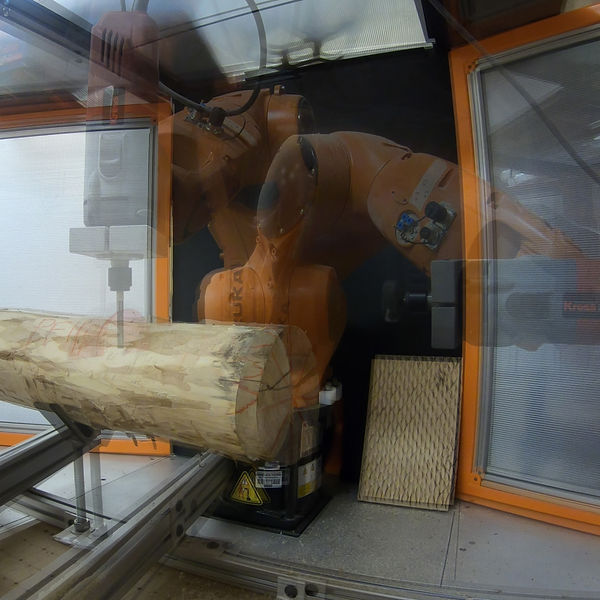
Robotics extend the mind, hand, and making relationships.
The interaction of computer processor with appendage and tool provide us with a framework to re-imagine making. What does making look like now that we have divorced our own human hand and kinetics from the process? Does this system provide fundamentally new opportunites? Can robotics catalyze the thinking and knowledge embodied in 3D scanning and computation?
CNC manufacturing forms the end of the line of this knowledge and thinking process, allowing us to act on our assumptions, and produce physical objects from raw resources. Can we use robotics to act surgically and minimize the amount of energy consumed in processing resources? Programming and directing these tools has become seamless with software we interface with on a daily basis.
Architecture is the medium to manifest integration.
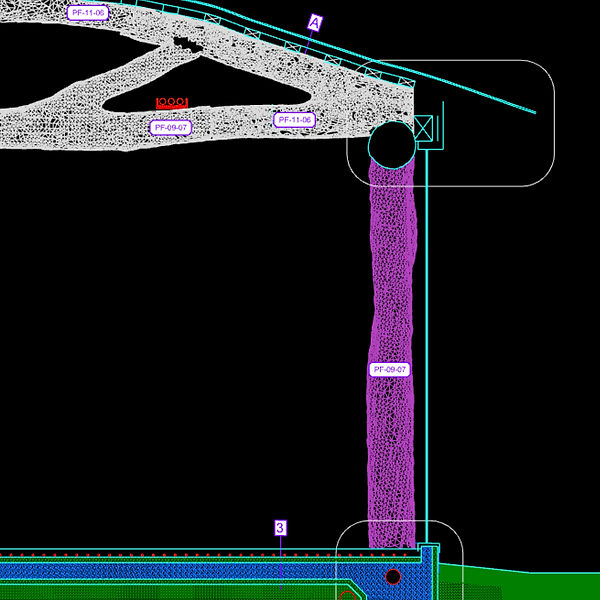
In addressing our fundamental needs for shelter and through the processes of consuming resources to produce this shelter, architecture is the catalyst and agency to re-imagine how we process and design with our natural resources. Architectural design can engender more sustainable forest practices by choosing the products and processes we use in converting resources to architectural products. Conversely, architects can specify forest products without any regard to their methods of sourcing or processing. These differing methods leave their record in varying impacts on the landscape and ecology.
Architecture is a medium of materials and construction. These materials have come from a place and through a process have been converted to architecture.